Important Dates
| Full Paper Submission | March 30, 2026 April 10, 2026 |
| Notification to Authors | April 25, 2026 |
| Registration Deadline | May 05, 2026 |
| Camera Ready Submission | May 15, 2026 |
| Conference Dates | May 15-16, 2026 |
A detailed instruction for how to submit paper in CMT is provided. For more detailed instructions on uploading materials to CMT, please check the following guidelines
CMT Submission Guidelines
Submission Guidelines
Authors are invited to submit original, previously unpublished research papers, describing particular challenges or experiences or proposing novel solutions relevant to the scope of the conference. Papers must present original and unpublished work and should not be currently under review by any other conference or journal. Papers should be written in English and formatted according to the Springer LNCS one-column page format. Papers must have a length of 12-15 pages in LNCS format. For more detailed guidelines, please visit official Springer Guidelines website.
For your convenience, both word and Latex templates are available for download:
For any issues related to the submission process, please, feel free to contact us: info@icetai.net
Proceeding Publication
The proceedings of all accepted and presented papers from the conference are planned to be submitted to Springer for publication in the book series STEAM-H: Science, Technology, Engineering, Agriculture, Mathematics & Health.

All papers accepted and presented from the conference will be published by Springer as a proceedings book volume in the STEAM-H book series. Springer will conduct quality checks on the accepted papers and only papers that pass these checks will be published.
Abstracted and indexed in: SCOPUS, zbMATH.
ISSN: 2520-193X E-ISSN: 2520-1948
Registration Information
The registration is mandatory for the author to present and publish the paper in the conference. At least one author of each accepted paper must register and pay the fee. For the In-Person registration, we offer a conference bag, tea breaks, lunch, one night dinner, certificate for participation, and access to all the sessions. For online registrations, only certificate for participation will be provided.
Author Dashboard / Register Now
Listener Registration Participant Login
The registration details are as below:
Registration Details
| Registration Type | Local (Turkey) | International | ||
|---|---|---|---|---|
| In-Person ($) | Online ($) | In-Person ($) | Online ($) | |
| Regular Author | 225 | 200 | 275 | 250 |
| Student Author (Must be first author) | 200 | 175 | 250 | 225 |
| Extra Page Charges (Each Page) | 25 | 25 | 25 | 25 |
| Listener (Non-Author) | 150 | 150 | 150 | 150 |
Participants from Istanbul Technical University receive a 50% registration fee waiver for one paper, provided the first author is from ITU. Each additional paper requires a full registration fee.

All technical support, registration handling, and related conference administrative services for ICETAI 2026 are managed by Multidisciplinary R&D Forum Ltd. (MRD Forum). MRD Forum is a UK-registered organisation providing academic event management, digital conference solutions, and event administration services.
Refund and Cancellation Policy:
Refund and cancellation requests must be submitted through the Author Dashboard within three calendar days of the payment date and no later than the published registration deadline, whichever occurs first. Each request must include the registrant's details, payment information, and a valid reason for cancellation.
Approved refunds will be issued after deducting any applicable bank, payment-gateway, currency-conversion, or administrative charges. No refunds will be provided after the registration deadline, once the paper has been included in the conference program, submitted for publication or proceedings production, or once conference or publication-related services have commenced. Refunds will also not be issued for non-attendance, withdrawal after the applicable deadline, visa refusal, travel disruption, or failure to participate in or present at the conference.
If the conference is cancelled by the organizers, the registration fee will be refunded or transferred to a rescheduled event. The organizers will not be responsible for travel, accommodation, visa, or other personal expenses incurred by participants.
Camera-Ready Guidelines
Authors of accepted papers are required to submit the following three mandatory files:
- Original Source Files of Paper(Latex or Word):
All the authors must either use Latex or Word file to format the paper. For your conveneince, we prodive both word and Latex files formats:
MS Word Template
Overleaf Latex Template -
PDF Version of Paper
You must convert your original source files (word or latex) into pdf version. -
Completely Filled and Signed Copyright Form
Download Copyright Form
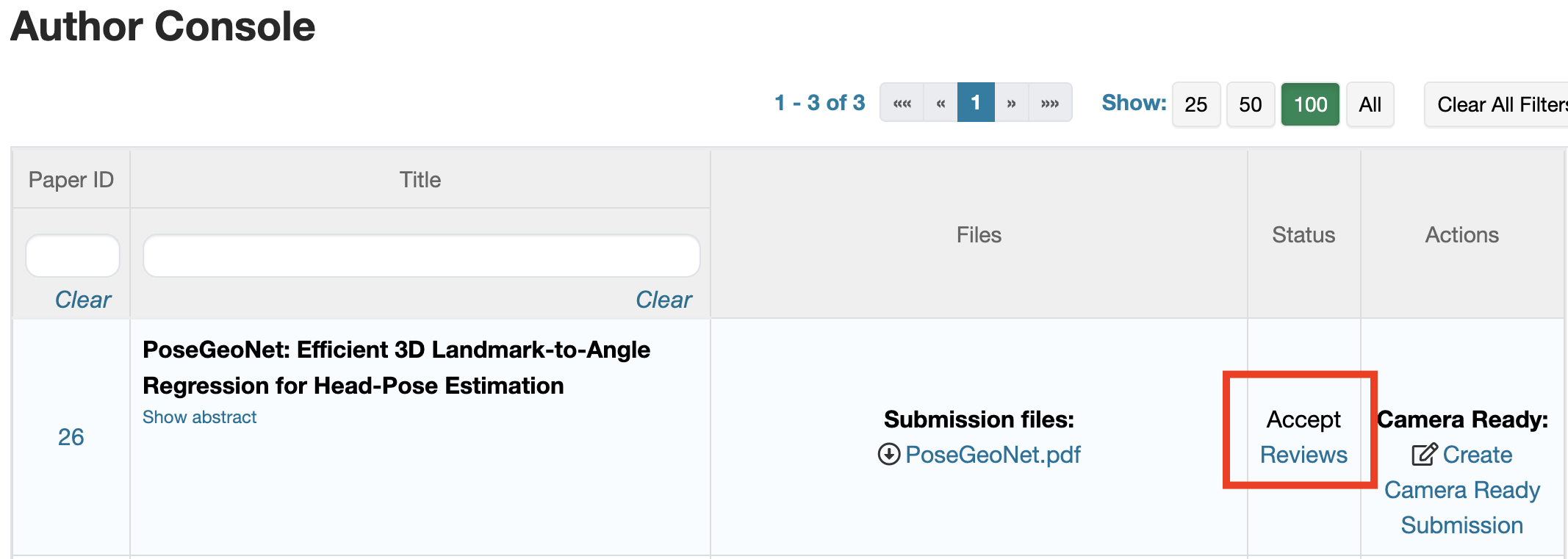
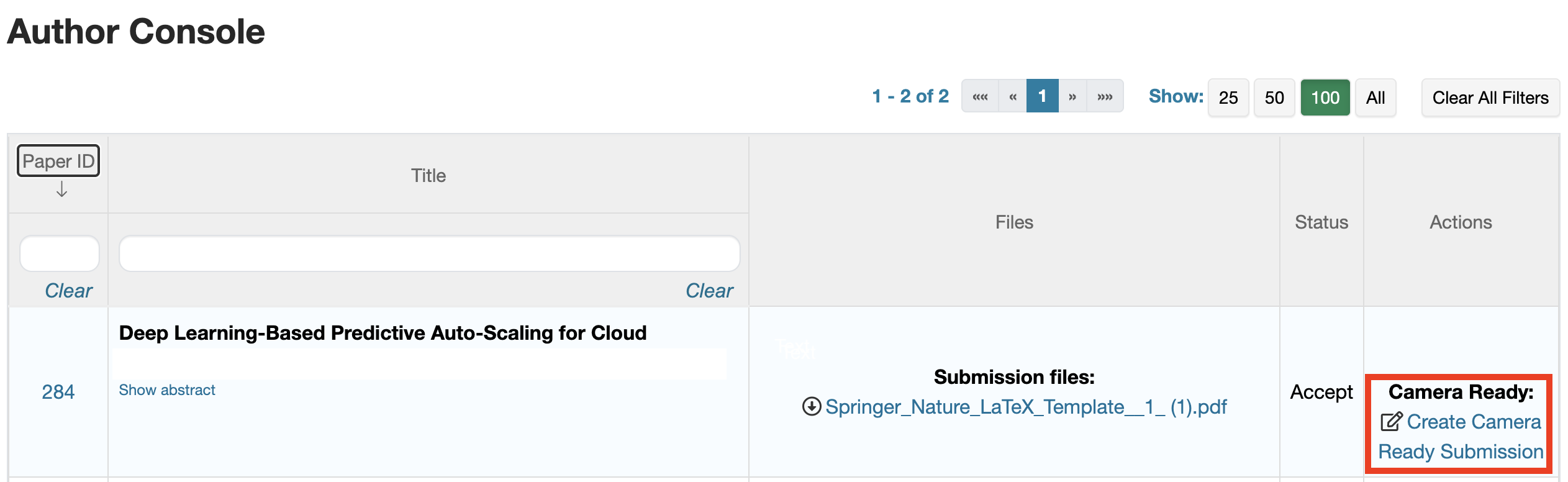
How to Upload Camera-Ready Materials via CMT
All camera-ready materials must be submitted through CMT. Follow the 4 steps below.
Log in to your CMT author account at the conference submission portal.
Go to your Author Dashboard and click on "Create Camera-Ready".
Verify all files are correctly uploaded, then click "Submit" to complete your camera-ready submission.
Note: Camera-ready submissions will not be accepted via email. You must use CMT to complete your submission.
Camera-Ready Submission Checklist for Authors
Please go through every point carefully before uploading your files to CMT.
Authors must prepare the camera-ready paper using the official Springer proceedings template in either LaTeX or Microsoft Word. Do not manually create your own format, change margins, reduce font sizes, or adjust spacing to force the paper into the page limit. The final paper must follow the template consistently from the title page to the references.
Submit the final source files along with the final PDF. For LaTeX submissions, include the .tex file, bibliography file such as .bib or .bbl, figure files, and supporting files. For Word submissions, submit the final Word or RTF file. The PDF must exactly match the final source file.
Authors must follow the page limit announced by the conference. Springer notes that full papers are commonly around 12–15 or more pages.
The title should be centered, written in 14-point bold font, and should clearly represent the main contribution of the paper. It should be concise, informative, and free from unnecessary abbreviations. Do not use a period at the end of the title. Avoid overly broad titles if the work is actually focused on a specific method, dataset, experiment, or application.
Use proper title-style capitalization. Important words such as nouns, verbs, adjectives, and adverbs should begin with capital letters, while short articles, conjunctions, and prepositions are usually not capitalized unless they appear at the beginning. For hyphenated words, capitalize the second part when appropriate, for example "User-Friendly."
Author names must be final, correct, and written consistently. Do not include titles such as Dr., Prof., Professor, PhD, Engr., Mr., or Ms. in the author line. Check spelling, order, and sequence of authors before submission.
If all authors are from the same institution, there is usually no need to put numbering such as 1, 2, 3 before author names. Numbering or superscript markers should mainly be used when authors are from different institutions or have multiple affiliations. Clearly mark one corresponding author in the paper header using an asterisk *.
Authors are encouraged to include their ORCID IDs according to the Springer template. Each ORCID must be correct and must belong to the relevant author only.
The abstract should briefly describe the problem, purpose, method, main results, and conclusion. It should be a compact summary of the whole paper, not just an introduction. Avoid citations, equations, tables, figures, bullets, and footnotes.
Keep the abstract concise and focused. If the conference specifies a word limit, follow it. Avoid vague statements and clearly state what was proposed, tested, evaluated, or found.
Add meaningful keywords after the abstract if required by the template. Use around 4 to 6 keywords unless the conference gives a different requirement.
Use the font provided by the official Springer template. Do not manually change fonts for decoration or emphasis.
Use numbered first-level and second-level headings only. First-level headings should be in 12-point bold, for example "1 Introduction." Second-level headings should be in 10-point bold, for example "2.1 Dataset Description." Do not use "0" in section numbering.
Third-level headings should be unnumbered run-in headings in 10-point bold. Fourth-level headings should be unnumbered run-in headings in 10-point italic. Avoid too many heading levels.
Explain background, research problem, motivation, research gap, main contribution, and paper structure. Keep it focused on the specific problem.
Compare the proposed work with existing studies. Do not only list papers; explain how your work differs or improves on earlier research.
Clearly explain approach, design, model, algorithm, dataset, preprocessing, experimental setup, and evaluation process where applicable.
Present results clearly and explain what they mean, why they matter, and how they compare with existing methods.
Summarize findings, contribution, and limitations. Prefer one clear paragraph; future perspectives can be added briefly at the end.
Use the same terms consistently across the paper unless terms intentionally have different meanings.
Define each abbreviation at first use and use it consistently afterward.
Number formal statements consecutively (e.g., Theorem 1, Theorem 2). Do not use section-based numbering such as Theorem 1.1.
Ensure all figures are clear, readable, and numbered as Fig. 1, Fig. 2, etc. Caption must be below each figure, and each figure must be cited in text.
Use vector graphics whenever possible. For line drawings, resolution should be at least 800 dpi, preferably 1200 dpi. Text inside figures should not be smaller than 6 pt.
Figures should remain understandable in black and white. Do not rely only on color; use line styles, labels, markers, patterns, or annotations.
You may include architecture diagrams, workflows, experimental setups, graphs, confusion matrices, sample outputs, or comparison charts. Ensure figures are not blurry, stretched, overcrowded, or low-quality screenshots.
Tables must be editable and must not be pasted as images. Number tables consecutively, place captions above tables, and cite each table in text.
Keep tables clean and within page margins. Avoid unnecessary vertical lines, excessive shading, colored text, or decorative formatting.
Avoid repeating the same information in both a table and a figure unless there is a strong reason.
Equations must be editable and not pasted as images. Displayed equations should be centered and placed on a separate line.
Number only equations referenced in text. Use consecutive numbering such as (1), (2), (3), and avoid section-based numbering like (1.1).
Equations should not be in color. Punctuate equations as part of the sentence where appropriate and define all symbols and variables.
Use footnotes only when necessary, and do not use footnotes in the abstract.
Code snippets should normally be in typewriter-style font, short, and relevant. Avoid long code blocks unless essential.
Do not use color in main text, tables, or equations. If colored figures are used, they must still be understandable in black and white.
Reference each figure, table, equation, section, and appendix properly in text using specific references (e.g., "Fig. 2 shows...").
Authors may be asked to provide alternative text for figures and image-based tables. Alt text should describe meaning, not just mention "image" or "graph."
Use numbered citations in square brackets, such as [1], [2], or [3-5]. Do not use superscript citations.
If the author's name is part of a sentence, cite like "Miller [9] was the first..." and avoid APA-style citations like "Miller (2020)."
Every in-text citation must appear in references, and every reference must be cited in text.
Follow Springer reference style only. Do not mix IEEE, APA, ACM, Harvard, or other formats.
Each reference must be complete and accurate. Authors should include full author names, complete title, journal or conference name, volume, issue, page numbers, publisher where applicable, year, and DOI where available. Incomplete AI-generated references must be corrected before camera-ready submission.
Verify all references suggested by AI tools. Replace incomplete entries with complete and verified bibliographic information.
Do not manually shorten author lists with "et al." when full author information is available.
Include DOIs wherever available to support stable linking and indexing.
Use Latin alphabet transliteration or translation and mention the source language where relevant.
Avoid irrelevant, unreliable, outdated, or weak references used only to increase reference count.
If included, place acknowledgments near the end before references, as per template rules, and keep them brief and relevant.
Include a disclosure statement if required. If none exist, state clearly that there are no competing interests relevant to the article.
If appendices are included, place them before references and label as "Appendix" or "Appendix 1, Appendix 2, ..." as required.
If allowed, include only relevant supplementary files, name them clearly, and refer to them properly in the paper.
Check grammar, spelling, punctuation, sentence structure, and academic tone for clarity across broad audiences.
Ensure problem statement, contribution, methodology, results, and conclusion are all clear and explicit.
Verify consistency of fonts, headings, captions, equation numbering, references, margins, spacing, and citation style.
Open the final PDF and inspect every page for title, authors, affiliations, abstract, keywords, headings, figures, tables, equations, references, and layout.
Presentation Guidelines
All authors are requested to carefully follow the guidelines below while preparing their presentation slides for ICETAI. These guidelines apply to both in-person and online presenters.
- In-person presentations: 20 minutes total, with 15 minutes maximum for the presentation followed by 5 minutes for Q&A.
- Online presentations: 15 minutes total, with 10-12 minutes for the presentation followed by 2-3 minutes for Q&A.
- Multiple authors may present their paper together, provided the presentation remains within the allocated time limit.
- The presentation should ideally contain 10-12 slides only. As a general guideline, presenters will have approximately 1 minute per slide.
-
Keep slides simple, clear, and professional:
- Avoid long paragraphs
- Use concise bullet points
- Use readable font sizes
- Avoid excessive animations and transitions
Recommended Presentation Flow
- Title & Authors
- Introduction / Motivation
- Objectives / Contributions
- Materials and Methodology
- Results & Discussion
- Conclusion / Future Work
- Q&A
Slide Design & Branding
- Use high-quality figures, tables, and charts that are clearly visible.
- Authors are encouraged to include the ICETAI logo and conference title on each slide.
Online Presentation Requirements
For online presentations, presenters must ensure:
- Stable internet connection
- Proper audio quality
- Uninterrupted electricity/power backup
- A quiet environment for presentation
Session Instructions
- Join the session at least 10 minutes before the scheduled time and keep your presentation ready in both PowerPoint and PDF formats.
- The session chair will invite presenters according to the sequence mentioned in the conference program.
- Presenters are requested to strictly follow the allocated time limit.
Review Process
- All submitted papers will be reviewed by at least three independent reviewers. Additional reviewers will be consulted if required.
- All papers will go through plagiarism checker. Plagiarism report must not exceed 15%
- All papers must be formated according to the given template .
- Paper acceptance will be based on originality, significance, technical soundness, and clarity of presentation.
- Authors must make sure that they submit previously unpublished papers to this conference.
Awards & Participation
- All accepted papers that are presented will be awarded a presentation certificate.
- The Best Paper certificate will be awarded to the author(s) of the best paper. The selection will be based on reviewers' comments and recommendations of the session chair.